Dispatch every transport from one live command center.
Private EMS dispatch should not depend on whiteboards, side spreadsheets, and phone-tag. CADMedic gives operations the call board, unit map, crew readiness, and time targets in one shared view.
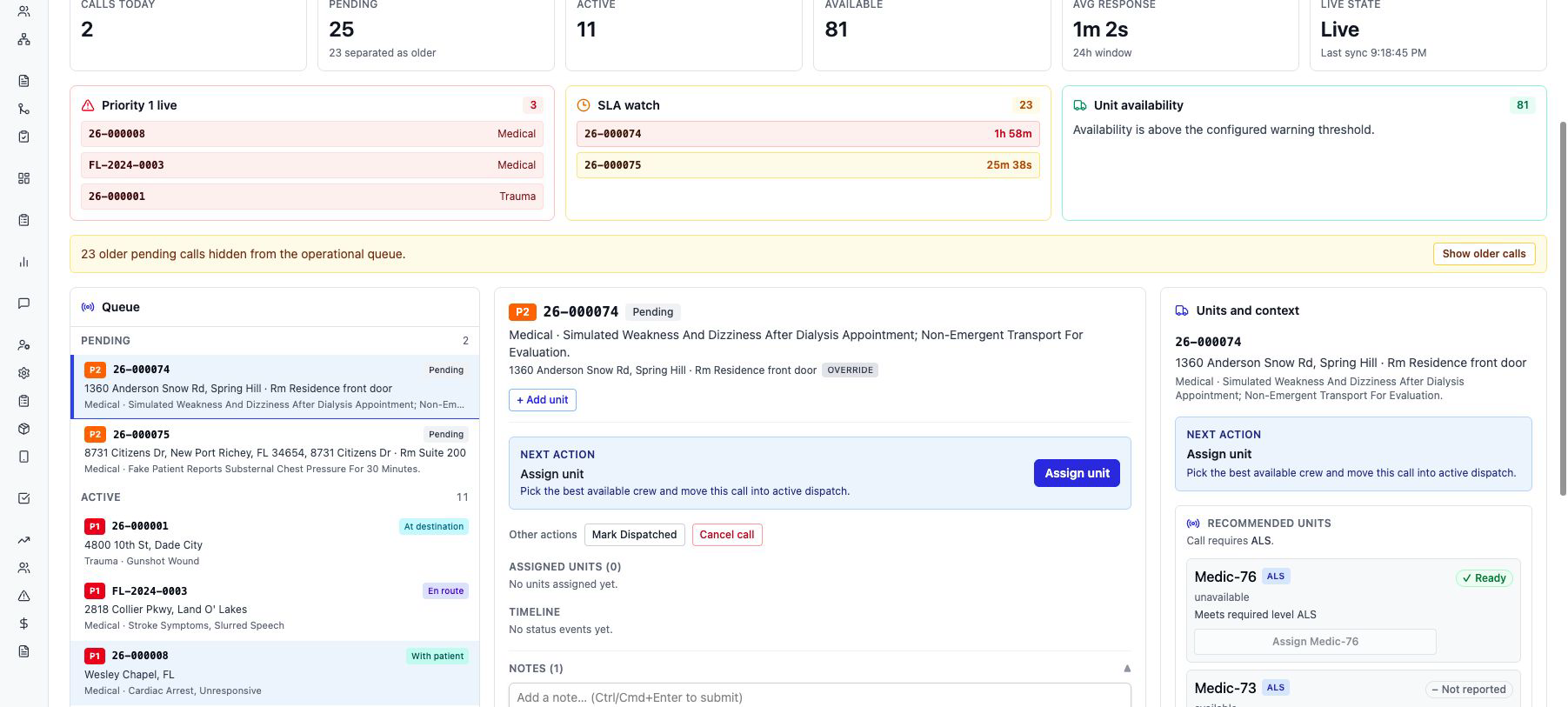
Real-time control across every call.
Everything a dispatcher needs to keep an IFT operation moving - one record, one board, one operational picture.
Real-time board
Every call moves through the full lifecycle — pending, dispatched, en route, on scene, transporting, at destination, cleared. No refresh, no stale state.
Live unit map
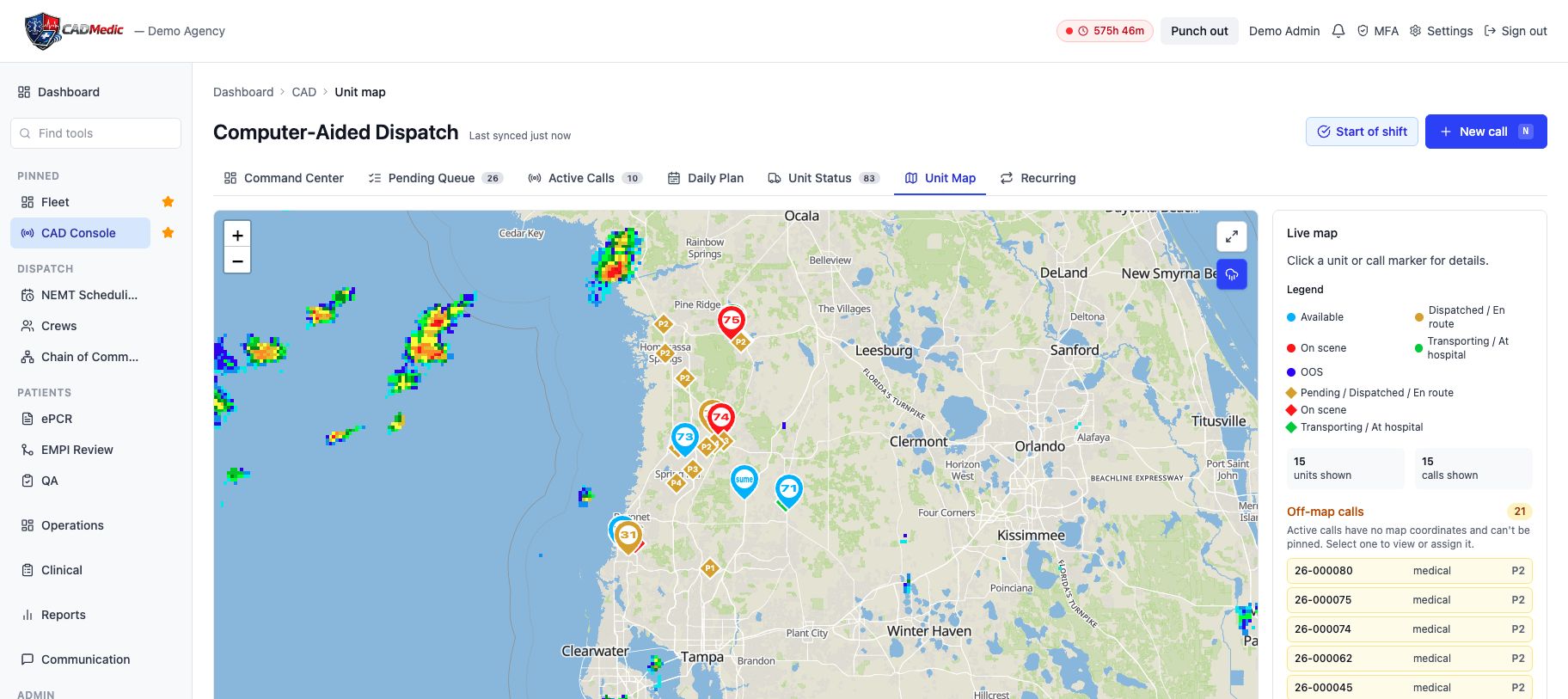
See units, calls, stations, service-area context, and operational weather layers together while routing and proximity work underneath.
Duplicate detection
Likely duplicate calls are flagged before they turn into double dispatches and wasted trips.
Time-target compliance
Track dispatch-to-on-scene and on-scene-to-clear against your agency's own SLA targets.
Alerts engine
Configurable alert rules with acknowledge and dismiss — every action captured in the audit trail.
Crew readiness
Start-of-shift readiness, equipment status, and unit assignment are built right into the board.
Know what happens next, not only what is happening now.
Live ETA, learned turnaround behavior, linked transport legs, readiness signals, and resource-gap economics give dispatchers a clearer view of the next decision.
Live back-in-service timeline
See travel, loading, transport, unloading, and recovery as one projected timeline that recomputes as the call advances and reality changes.
Learned turnaround predictions
CADMedic learns phase timing from your own operations, including facility, level of service, time of day, equipment needs, weather, fuel, and shift context.
First-class wait-and-return
Keep outbound and return legs connected with clear call badges, assignment continuity, crew guidance, separate care records, and billing context for each leg.
Lost-call and revenue intelligence
Capture when a trip is declined for lack of crew or vehicle, then quantify resource gaps and projected lost revenue without exposing PHI to leadership reporting.
Readiness distinct from availability
A unit can be unassigned without being road-ready. CADMedic separates dispatch status from rig readiness and shows spare vehicles available near each station.
Bring-your-own phone integration
Connect supported business phone systems for inbound screen pops, caller context, call linking, and dispatch-call KPIs while keeping your existing voice provider.
Recommendations that respect the business reality of the shift.
CADMedic can rank available options using clinical requirements, crew capability, GPS location, schedule context, and agency economics. The dispatcher stays in control at every step; recommendations never force an assignment.
Requirement-aware recommendations
Call requirements such as ALS level, IV medications, pumps, ventilator needs, and agency capability rules help surface crews that can actually handle the trip.
Schedule and overtime context
CADMedic weighs who is actually available, how their shift is unfolding, and whether an assignment risks avoidable overtime or turnaround friction.
GPS and economics in one view
CADMedic scores practical options using location, ETA, distance, transport mileage, unit cost, expected revenue, and net-benefit signals.
Put the next truck closer before the next call drops.
CADMedic brings System Status Management principles into the dispatch workflow, using each agency's own history to show demand and guide unit positioning while keeping dispatchers in control.
Predictive demand modeling
CADMedic rolls up the agency's own call history by location, hour of day, and day of week into a demand map with typical and high-end (p50/p90) demand. Stronger seasonal forecasting is planned, not yet built.
Demand heatmaps and analytics
A visual heatmap and time-of-day demand clock show supervisors where calls concentrate, helping with shift design, staffing plans, and smarter station or post decisions.
Your deployment model, your choice
Run station-based coverage, post units dynamically across the service area, or blend both. CADMedic adapts to how your agency actually operates.
Coverage-aware move-ups
As units go busy and clear, CADMedic continuously scores coverage and suggests post locations or move-ups that keep the service area protected. Dispatchers see the recommendation and stay in control.
Built for crews, not just the map
Redeployment logic can respect post-move limits, minimum dwell times, fair rotation, and a preference for locations with real amenities, improving coverage without grinding down your people.
Prove the impact
Leadership can track response-time compliance, 90th-percentile performance, unit-hour utilization, and forecast accuracy over time so deployment changes are backed by real evidence.
CADMedic turns call history into a living demand model: location, hour, day-of-week, and seasonal signals feed heatmaps, a demand clock, and coverage scoring. New agencies get useful models quickly, and predictions sharpen as more history accumulates. When coverage shifts, CADMedic recommends posts and move-ups with the operational reasons visible to the dispatcher. The software recommends; people decide.
The board shows what changed. The map shows where it matters.
Active calls, unit status, and location context stay together so dispatch can allocate the right crew faster.
Dispatch is where reimbursement starts.
The transport call created here becomes the crew's ePCR and, in turn, the ambulance billing record. Cleaner data at intake means less rework downstream.
Interested in CADMedic?
CADMedic is built and in internal testing. I'm open to the right EMS agency or software company taking it further, whether that's piloting it, adopting it, or bringing it in-house.